E-invoicing
in XML.
Introduction
If you invoice clients in the Netherlands, Germany, Belgium, Sweden, or elsewhere in the EU, you have probably already heard the term e-invoicing coming up more often. Some of your clients may have already asked for it. And if they haven't yet, there's a good chance they will — because across Europe, structured electronic invoices are either already mandated or rapidly becoming the expected default.
Cannelle now supports XML invoice export in the UBL 2.1 format — the most widely recognised e-invoicing standard across the EU. You can generate an XML file for any invoice with a single click, download it immediately, and it is also saved automatically as a document attachment on the invoice.
This post explains what that means in plain terms, why it matters, and who needs to care about it.
What is e-invoicing, really?
A regular PDF invoice is designed for a person to read. It looks good on screen and prints cleanly, but when your client's accounting system receives it, someone still has to type the numbers in manually — or the system has to guess its way through OCR and hope for the best.
An e-invoice is different. It is a structured file — specifically an XML file — that carries all the same invoice data in a format that any accounting software can read and process automatically. Invoice number, date, line items, tax rate, total amount, your VAT number, your client's VAT number — all precisely labelled, no ambiguity, no manual keying.
The practical result for your client: they receive your invoice, import the XML file into their system, and it appears correctly booked — no data entry, no mistakes, no chasing. For you: fewer queries, faster payment approval, and a cleaner paper trail.
Looks good. A person can read it easily. But another person — or OCR software — has to re-enter the data on the other side.
Contains exactly the same information, structured for machines. Your client's accounting system processes it automatically, with no manual input.
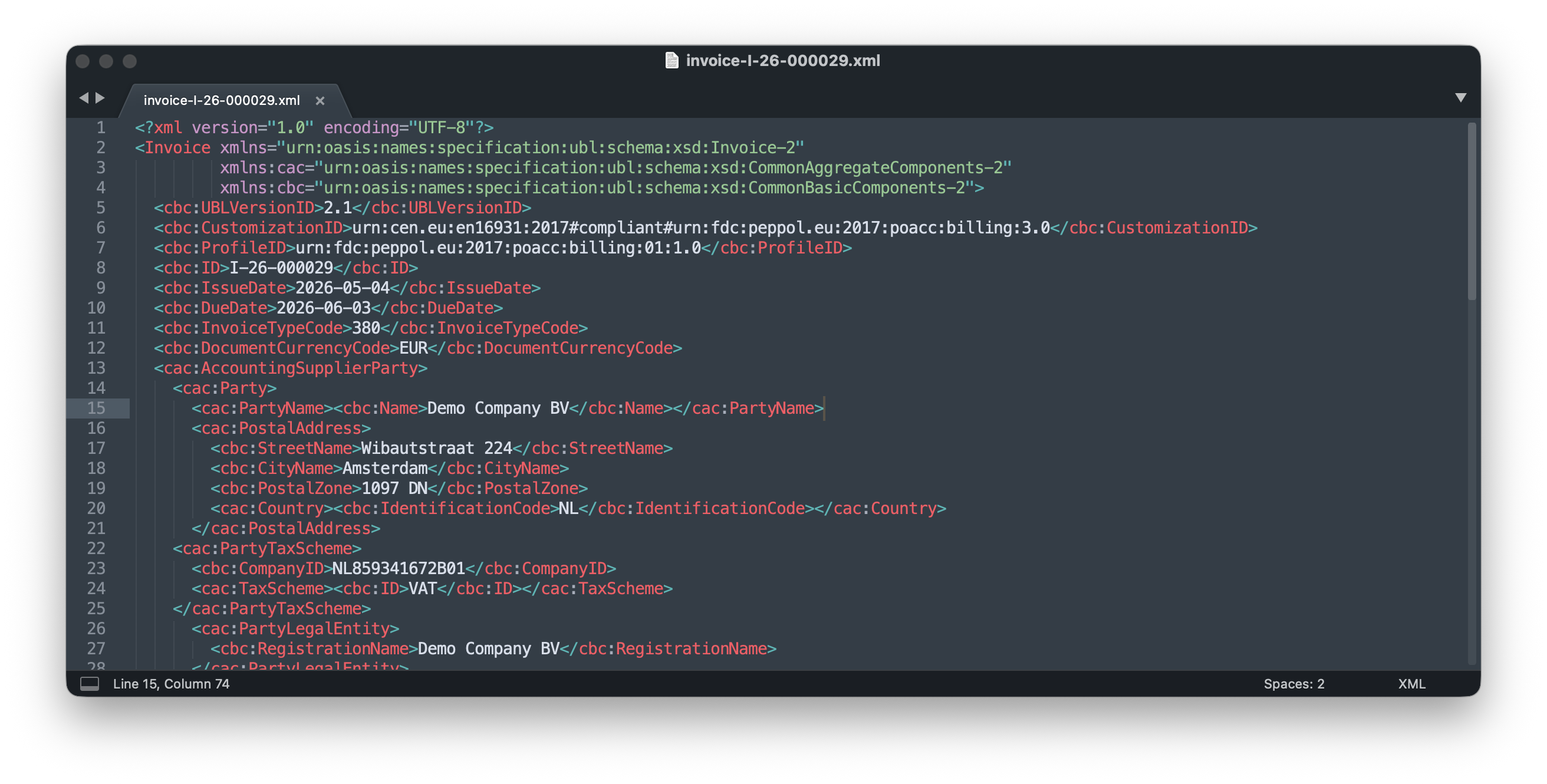
// both, not either/or
You do not have to choose. Cannelle generates both. Send your client the PDF as usual, and attach the XML alongside it when they ask for it — or when their system requires it.
A word on standards
E-invoicing standards can feel like alphabet soup — UBL, CII, Peppol, eFatturaPA, Factur-X. They are all trying to solve the same problem, but they evolved differently across countries and industries. Here is a brief map of what exists and where Cannelle fits in.
UBL 2.1
Universal Business Language — the most widely adopted e-invoicing format in the EU. Mandated or recommended in the Netherlands, Belgium, Denmark, Norway, Sweden, and many others. This is what Cannelle generates.
Peppol BIS 3.0
The cross-border EU network standard. Built on top of UBL 2.1, with additional validation rules. Used when invoices travel through the Peppol network — common in public sector procurement across the Netherlands, Germany, and Scandinavia.
Factur-X / ZUGFeRD
The French and German hybrid format: a regular PDF with the XML data embedded invisibly inside. The PDF looks normal to a person; the software reads the XML. Increasingly expected for B2B invoicing in France and Germany.
eFatturaPA
The Italian public sector e-invoicing standard — mandatory for all invoices to Italian government entities and, since 2019, for most B2B transactions in Italy as well.
// the short version
If your clients are in the Netherlands, Belgium, Denmark, Sweden, or Norway — or if you work with any EU public sector organisation — UBL 2.1 is almost certainly what they need, and Cannelle already produces it. The other formats are on the roadmap.
How it works in Cannelle
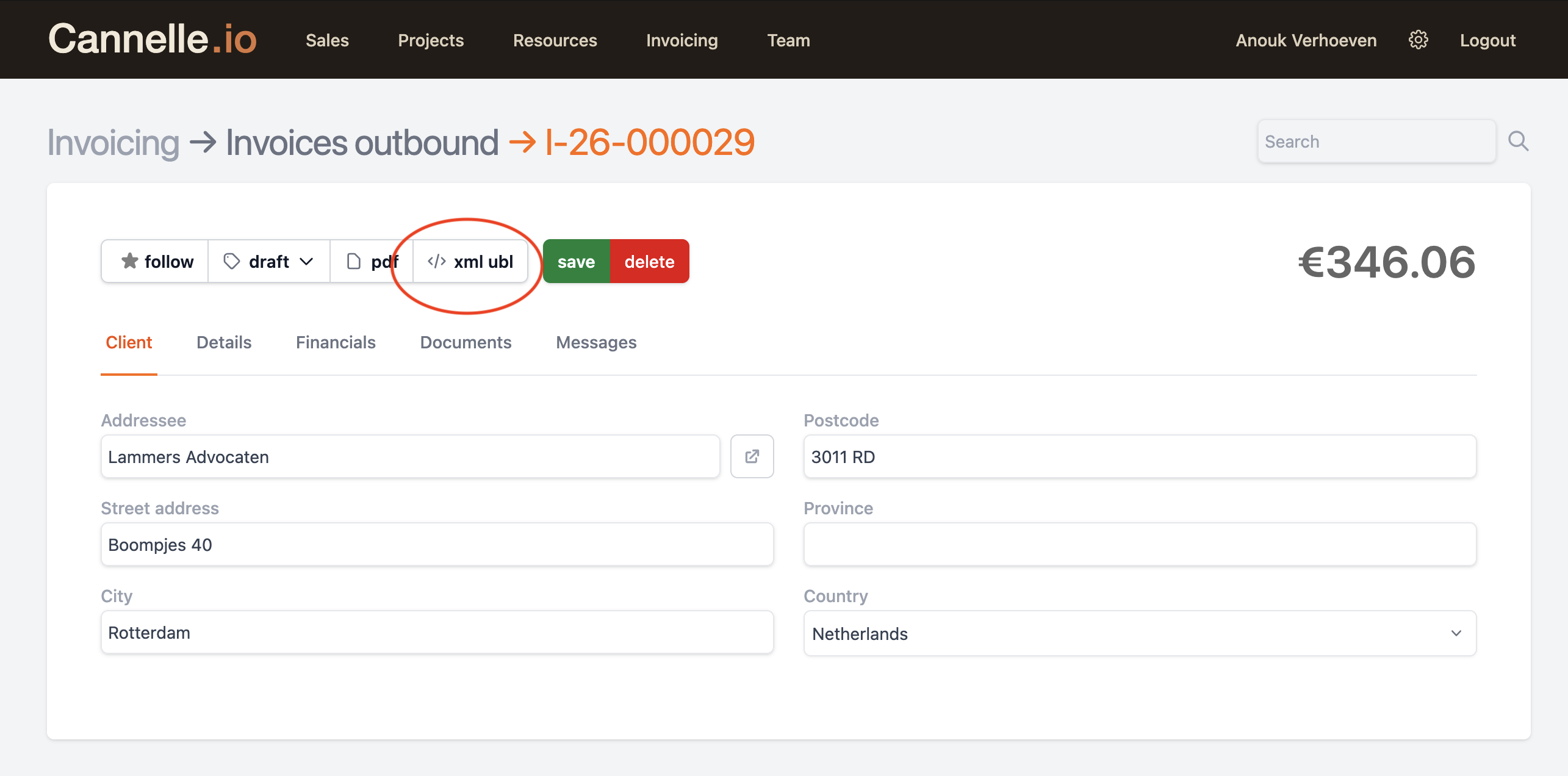
Open any invoice. In the action bar at the top of the page, next to the PDF button, you will find a button labelled XML UBL. Click it and the file downloads immediately — no settings to configure, no extra steps.
The file is named after your invoice reference, so invoice-INV-2026-0042.xml is what you
get for invoice INV-2026-0042. You can attach it to an email alongside your PDF,
or upload it directly to your client's supplier portal.
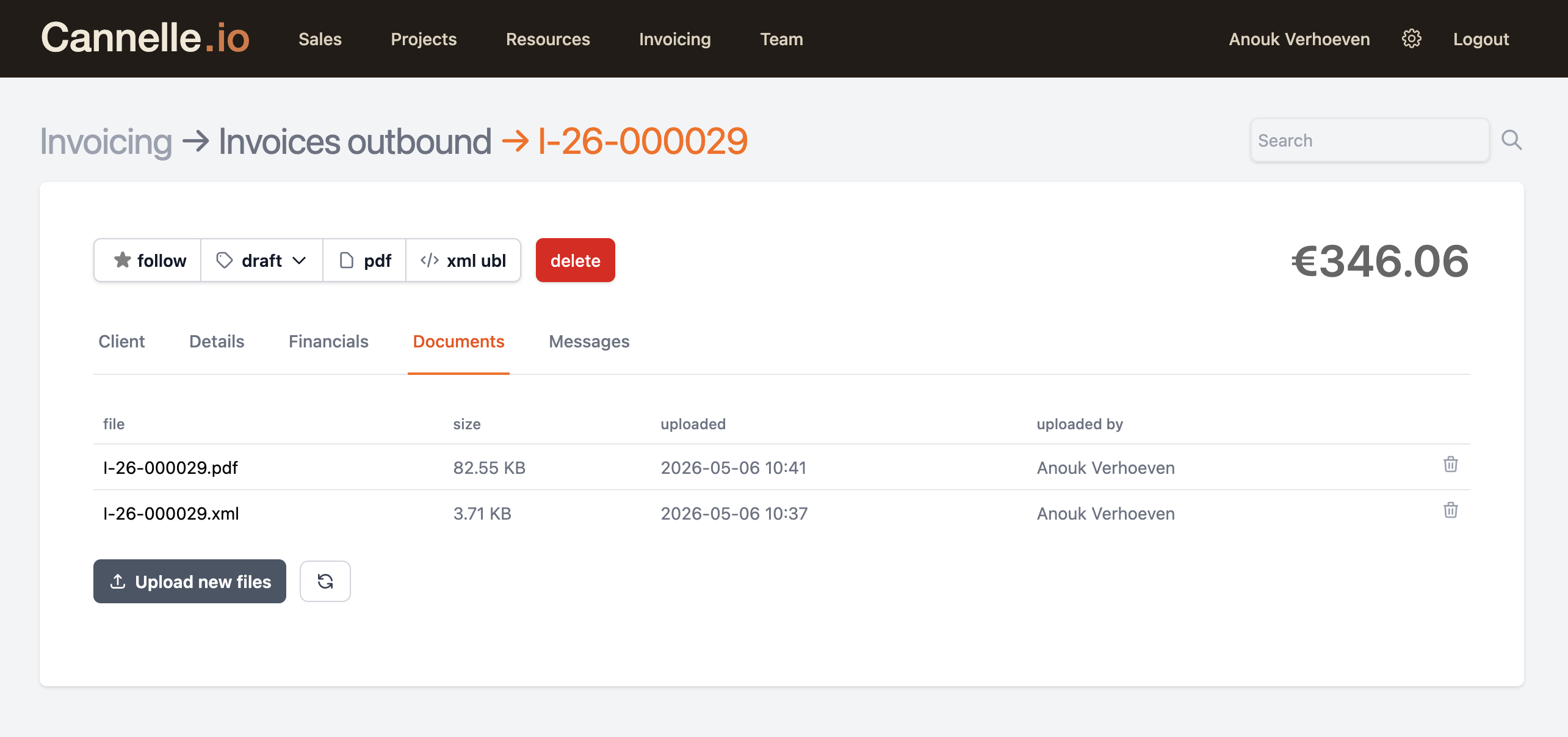
Saved automatically as an attachment
Every time you generate an XML file, Cannelle saves it as a document attachment on the invoice. You will find it in the Documents tab, alongside any PDFs and other files you have attached to that invoice.
This means you do not have to remember where you saved the file. If you need to send it again — or if your client asks for it three months later — it is right there in the invoice record, always.
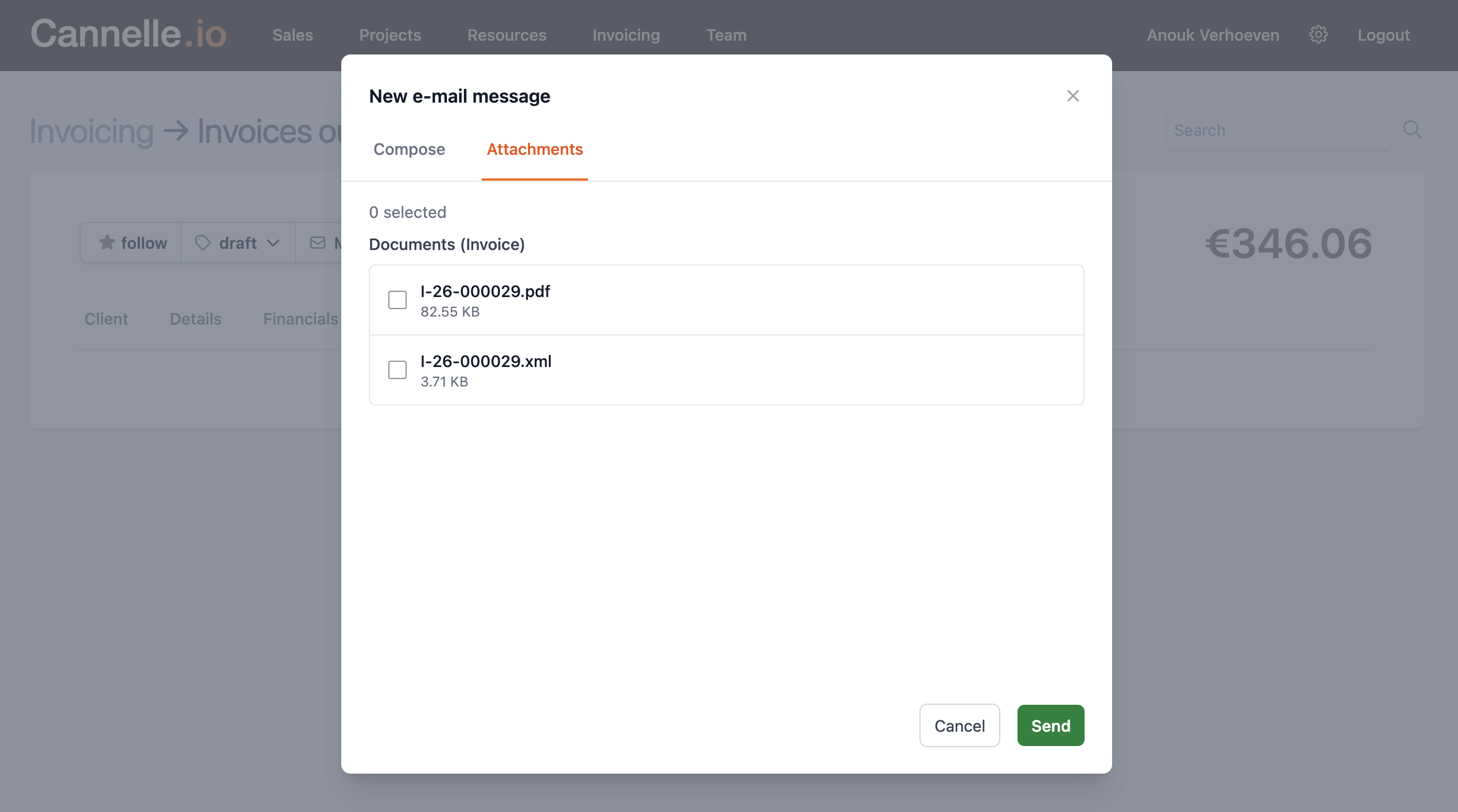
The XML attachment is also included automatically when you send a new invoice-related message from within Cannelle. Anyone reading the message thread can download it directly, without going back to the Documents tab.
Is this relevant for you?
Not every business needs to think about this today. But if any of the following sound familiar, it is worth knowing the feature is there.
You invoice clients in the Netherlands, Belgium, Denmark, Sweden, or Norway
These countries have either mandated or strongly normalised UBL 2.1 e-invoicing for business-to-business transactions. Larger clients in particular may already require it or will do so soon.
You invoice any EU public sector organisation
Under the EU e-invoicing directive, all public sector buyers must be able to receive structured electronic invoices. In most member states, UBL 2.1 is the accepted format. If you do any public sector work, this applies to you.
A client has asked for a "structured invoice" or "e-invoice" and you weren't sure what they meant
They almost certainly meant a UBL XML file. Now you can give them one.
Your clients' accounts payable teams keep asking questions about your invoices
If you regularly get requests like "can you resend as a different format?" or "our system couldn't read the PDF", an XML invoice eliminates the problem at the source.
You want to future-proof your invoicing workflow
The EU's e-invoicing mandate is expanding. What is voluntary today in several countries will become mandatory within the next few years. Getting into the habit now costs nothing.
// if you are not sure
The easiest way to find out whether a client needs XML is to ask them. Something like: "We now support UBL 2.1 XML invoices — would that be useful for your accounts payable process?" Most finance teams will know immediately, and the ones who say yes will appreciate you asking.